Working Paper explores how authoritarianism represents a structural risk multiplier for human rights decline and conflict
Authored by Emma Bapt and Adam Day, our recent research explores how authoritarianism represents a structural risk multiplier for human rights decline and conflict.
As authoritarian practices expand across regions, reversing decades of human rights progress, the Working Paper, ‘The Slippery Slope of Authoritarianism – Using Human Rights to Anticipate and Prevent Conflict,’ offers a set of lessons and considerations for policymakers and leaders to take early, effective action to prevent a slide into violent conflict. The paper emphasizes the often-overlooked role of economic, social and cultural rights in prevention and adopts a political economy lens to understand how authoritarian systems reproduce structural inequalities.
This research builds on a previous two-part research series that explores how the United Nations’ human rights system can serve as a tool in conflict prevention, resilience and early warning. It found that the UN human rights system produces unique and actionable early warning signals of violent conflict, especially in highly centralized settings where political power and resources are consolidated in a small elite in an authoritarian system. In some cases, the human rights system may generate the best indicators that a system is beginning to tilt towards violent conflict. Key findings include:
- Authoritarianism is a threat multiplier
- Structural inequalities are a central risk factor
- Access to resources matters
- Divisive rhetoric is a powerful early warning tool
- Corruption and human rights are deeply connected
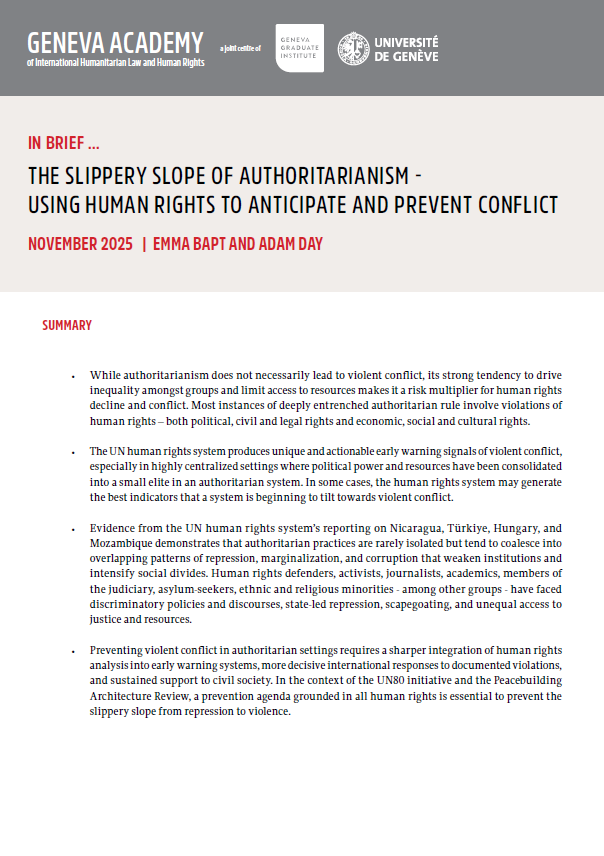
The In-Brief…, ‘The Slippery Slope of Authoritarianism – Using Human Rights to Anticipate and Prevent Conflict‘, summarizes the key findings and recommendations from the Working Paper.
In the context of the UN80 initiative, the 2025 Peacebuilding Architecture Review and other UN processes, a prevention agenda grounded in all human rights — political, civil, legal, and economic, social and cultural — is essential to prevent the slippery slope from repression to violence. Human rights mechanisms provide detailed, credible evidence of risks that, if acted upon, can slow or even prevent this slide. The central challenge is to move from recognition to action, translating the signals of human rights decline into timely preventive strategies.