New Working Paper on the Targeting of Disinformation Towards Children in Russia and Temporarily Occupied Ukrainian Territories
Contemporary armed conflict increasingly extends beyond kinetic violence into the information and cognitive domain. Within this landscape, children are uniquely vulnerable. Their developmental stage makes them particularly susceptible to long-term manipulation through education systems, digital environments, cultural policy, and state-directed youth structures.
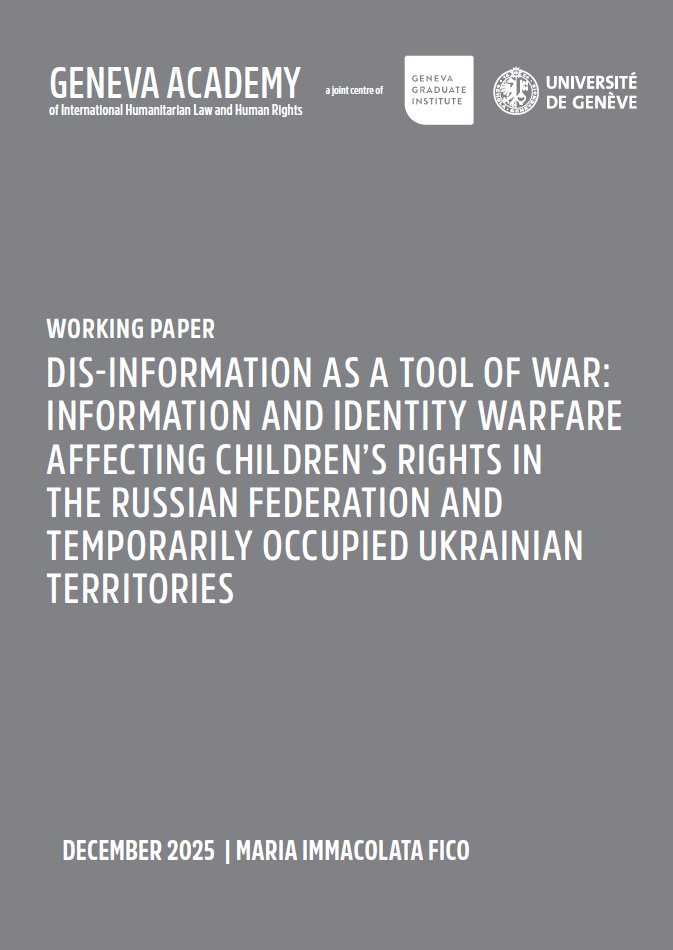
Based on this premise, our recent working paper, ‘Disinformation as a Tool of War: Information and Identity Warfare Affecting Children’s Rights in the Russian Federation and Temporarily Occupied Ukrainian Territories‘ examines how disinformation functions as a central instrument of contemporary warfare, focusing on its impact on children’s rights in the Russian Federation and temporarily occupied Ukrainian territories.
The study, written by research collaborator Maria Fico, demonstrates that disinformation operates as part of a coherent system of ‘cognitive warfare’, in which multiple practices, indoctrination, digital censorship, forced transfers, and militarized youth programming, work together to shape children’s identities, beliefs, and loyalties.
By controlling education, information access, cultural identity, and family ties, these practices raise serious concerns under international human rights law (IHRL), international humanitarian law (IHL), and international criminal law (ICL). As an original contribution to the discourse, the relevant standards under international law have been mapped throughout all the paper.
This research identifies four interlinked mechanisms that together form a coherent system of cognitive warfare targeting children:
- Indoctrination in Education: Russia’s curricula, textbooks, and youth-organizations institutionalize patriotism, militarism, and loyalty to the State. In the temporarily occupied territories of Ukraine, Ukrainian-language instruction is dismantled, and Russian ideology imposed. These measures raise concerns particularly regarding cultural identity, non-discrimination, and the use of education in contexts of occupation, with possible implications under criminal accountability.
- Digital Censorship and Surveillance: In Russia, the Sovereign Internet Law and school-based monitoring systems isolate children from independent information and restrict expression. In temporarily occupied territories of Ukraine, rerouted infrastructure and device checks block Ukrainian media and render online Ukrainian schooling unsafe, affecting the access to information and continuity of education.
- Forced Transfers and ‘Re-Education Camps’: Thousands of Ukrainian children have been unlawfully deported, naturalized as Russian citizens, placed in ideological “re-education” camps, or subjected to militarized youth training. These acts raise concerns under the prohibitions on forcible transfer, identity erasure, and war propaganda.
- Militarized Youth Organizations: Russia’s youth movements – Yunarmiya, The Movement of the First, and others – operate as state-directed tools of ideological conditioning and militarized socialization. Children, some as young as 6, are drawn into training, loyalty rituals, and patriotic programs, often under coercive conditions. In occupied Ukrainian territories, these structures advance Russification and pre-recruitment preparation, with participation tied to access to education or services. All raising serious concerns particularly regarding forced participation and the militarization of children in conflict settings.
- Regional Dimension – Belarus: Similar strategies appear in Belarus and influence information operations in neighbouring states, confirming that Russia’s model of cognitive warfare and childfocused identity manipulation extends beyond Ukraine and undermines regional human rights protections.
Importantly, the research stresses that these practices are mutually reinforcing and systematic, targeting children’s development, identity, and access to information. As such, they raise serious concerns under international human rights law, international humanitarian law, and international criminal law.
The working paper concludes that protecting children from disinformation and identity-based manipulation is not optional, but fruit of binding obligations undertaken by States under international law. It calls for stronger international action, including accountability through international criminal mechanisms, enhanced child-protection responses, and improved regulation of digital platforms to prevent the spread of harmful narratives in conflict settings.
In this regard, the working paper sets out targeted recommendations for key actors across different levels, including the UN Human Rights Council, UNICEF and the Committee on the Rights of the Child, the Council of Europe, the International Criminal Court, the Russian Federation, Ukraine and Belarus, third-party States, international humanitarian and child-protection actors such as the ICRC, UNHCR and IOM, as well as social media platforms and child-protection and mental health professionals.
Overall, the study positions disinformation as an integral and evolving method of warfare, requiring urgent legal, policy, and operational responses to safeguard children and uphold the integrity of the international legal order.
A concise ‘In Brief‘ version accompanies the study, translating its findings into accessible, ready to use policy-oriented insights.