New Working Paper Identifies Regulatory Gaps in UN Draft Instrument on Private Military and Security Companies
Private military and security companies play an increasingly prominent role in contemporary conflicts and security operations worldwide, raising complex challenges for international law and weapons control frameworks. While various non-binding standards — such as the Montreux Document on private military and security companies (PMSCs) and the International Code of Conduct for Private Security Service Providers — seek to guide states and companies on legal compliance, existing regulatory gaps persist.
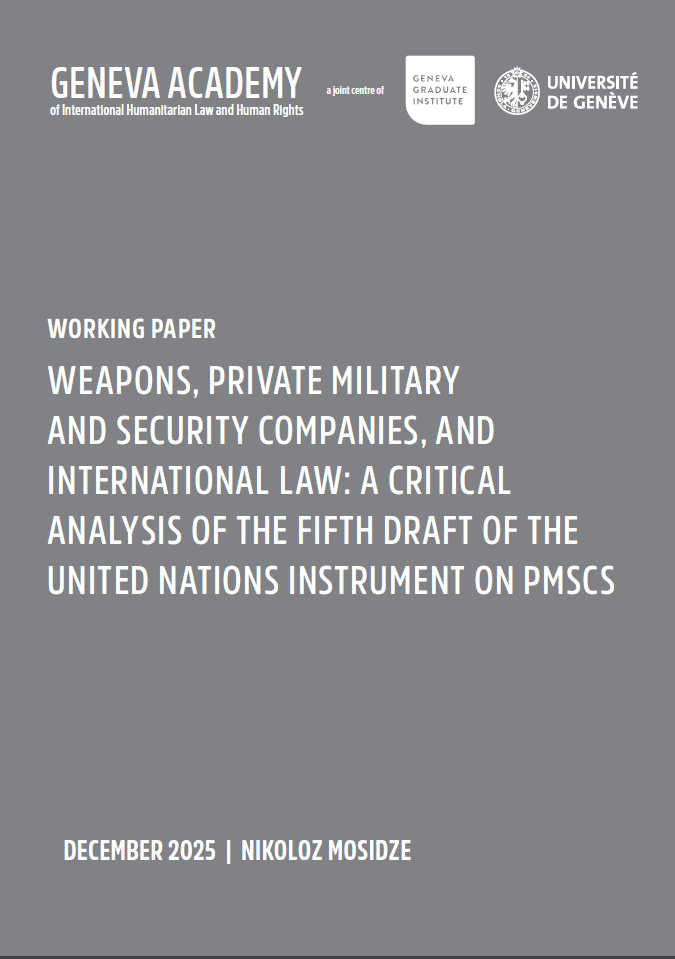
A new working paper from the Geneva Academy of International Humanitarian Law and Human Rights, written by Nikoloz Mosidze, critically examines the Fifth Draft of the proposed United Nations instrument regulating PMSCs and calls for stronger international legal standards to address weapons proliferation risks linked to these actors. The paper, ‘Weapons, Private Military and Security Companies, and International Law: A Critical Analysis of the Fifth Draft of the United Nations Instrument on PMSCs‘, assesses how the latest draft proposal from the United Nations intergovernmental working group aligns with — and diverges from — established international legal principles.
The author identifies several critical shortcomings in the draft instrument that could undermine its effectiveness in preventing unchecked proliferation and misuse of weapons in international and non-international armed contexts:
- Ambiguous terminology: The paper argues that the instrument should consistently use the term ‘weapons’ rather than alternating with the narrower term ‘conventional arms’ to avoid loopholes and legal uncertainty that could be exploited.
- Comprehensive scope: It highlights the need for the instrument to apply unambiguously to all PMSCs, their personnel, and subcontractors, ensuring there are no regulatory blind spots.
- Maritime proliferation risks: The analysis stresses the importance of including clear regulatory provisions for PMSC activity in the maritime domain — including vessel-based operations and floating armouries — which present significant risks for weapons transfers and diversion.
- Weapons diversion: The paper calls for explicit safeguards against the diversion of weapons through PMSC networks — a major and well-documented pathway for uncontrolled proliferation that is not adequately addressed in the current draft.
- Transparency and accountability: Introducing mandatory record-keeping and reporting obligations for weapons-related activities involving PMSCs is recommended to enhance traceability, accountability, and compliance with international law.
The paper’s recommendations aim to strengthen the legal clarity, accountability mechanisms, and regulatory reach of the proposed instrument — steps the author considers essential to prevent PMSCs from undermining international weapons control regimes. This working paper contributes to ongoing international policy discussions on PMSC regulation and complements other Geneva Academy research on accountability, human rights, and armed actors in conflict settings.