New Working Paper Examines How the Targeting and Repression of Sexual Orientation and Gender Identity Minorities in Russia Impacts Human Rights
Authored by Emma Bapt and Rose Sandford, our recent working paper examines how the targeting and repression of sexual orientation and gender identity (SOGI) minorities in the Russian Federation functions as a core component of Russia’s authoritarian playbook, with severe consequences for human rights and civil society space both in Russia and beyond.
As Russia has increasingly weaponized ‘traditional values’ narratives, securitized LGBTQ+ identities and mobilized religious, societal and non-state actors to enforce repression, SOGI minorities have become ‘invisible citizens:’ acknowledged in rhetoric but progressively erased from legal protection and public life. The Working Paper ‘Invisible Citizens: How Targeting and Repression of Sexual Orientation and Gender Identity Minorities in Russia Impacts Human Rights’, documents how these strategies have normalized discrimination, enabled increased violence and accelerated broader human rights erosion.
The paper traces the historical evolution of SOGI repression in Russia, culminating in the 2023 Supreme Court decision designating the so-called ‘International LGBT Movement’ as’ ‘extremist.’ It adopts a political and legal analysis grounded in international human rights law, drawing on 20+ interviews with UN representatives, Russian LGBTQ+ organizations, LGBTQ+ activists, regional and international NGOs, researchers and academic experts, as well as extensive UN reporting.
Crucially, the research situates SOGI repression as an early warning signal of authoritarian consolidation. It demonstrates how the targeting of LGBTQ+ communities often precedes wider crackdowns on civil society, freedom of expression, and political opposition, patterns increasingly mirrored across Eastern Europe and beyond.
Key findings include:
- SOGI repression is State-driven and systematic, not incidental
- ‘Traditional values’ narratives function as tools of political control
- Securitization of LGBTQ+ identities enables the misuse of counter-terrorism and extremism laws
- Religious, societal and non-state actors play a critical role in enforcing repression
- The targeting of SOGI minorities is a key early warning sign of human rights backsliding
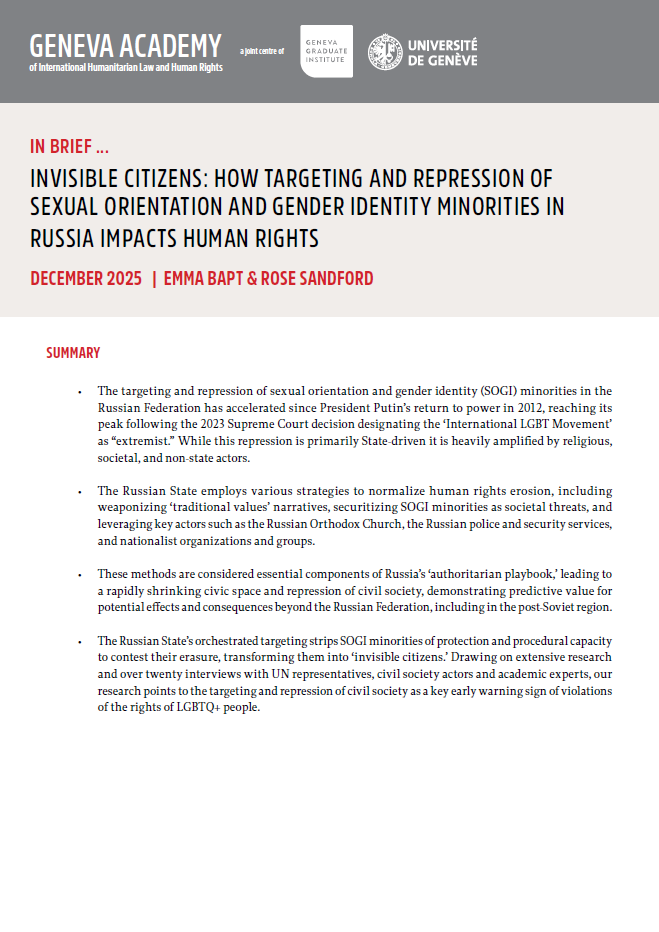
The paper also documents the remarkable resilience and adaptability of Russian LGBTQ+ civil society while highlighting the urgent funding, protection and access challenges organizations and groups face both inside and outside the Russian Federation.
Published alongside the working paper, ‘In-Brief…‘Invisible Citizens: How Targeting and Repression of Sexual Orientation and Gender Identity Minorities in Russia Impacts Human Rights’ summarizes the key findings and policy recommendations.
In the context of rising authoritarianism, shrinking civic space, the UN80 initiative, and broader debates on prevention and accountability, this research underscores the need to treat SOGI repression not as a marginal issue but a structural indicator of human rights decline. Protecting the rights of LGBTQ+ persons is essential for those LGBTQ+ communities directly affected and for safeguarding the universal applicability of fundamental human rights.